
Last spring, some of my friends were going on a trip and I wanted to join them. However, I had research-related responsibilities that I needed to prioritize. As I walked to my lab in the beautiful weather, I resolved to replace the word “can’t” with “won’t” in my mental dictionary. Instead of thinking that I could not go, I decided to shift my mindset and think that I would not go because I chose to focus on my work at the time. I thought of what I could accomplish because of deciding to stay back. I made a conscious decision to look on the bright side. That renewed my enthusiasm for my work and I felt much better. That’s when I realized that every thought is a choice and every situation is an opportunity.
In both personal and professional life, missing out on some things turned out to be a blessing in disguise. Some failures made me determined to double my efforts. Some redirected me to channel my energy elsewhere. Some bad experiences became powerful lessons. The important thing I realized is that you get to choose your narrative. What do you want this phase to mean to you? If you keep staring wistfully at the closed door, you won’t notice if another has opened. And sometimes, you need to unlock it yourself.
Taking control of your mind by consciously choosing your attitude is the first step towards taking control of your life. When external influences put you in a tough spot, think about what you should have done differently and how you can overcome it now. Only when you take responsibility of your own mistakes can they become lessons. Only when you own the problem can you fix it. This thought process signals to your mind that the outcome of every effort is in your hands. You stop complaining. And you get to work.
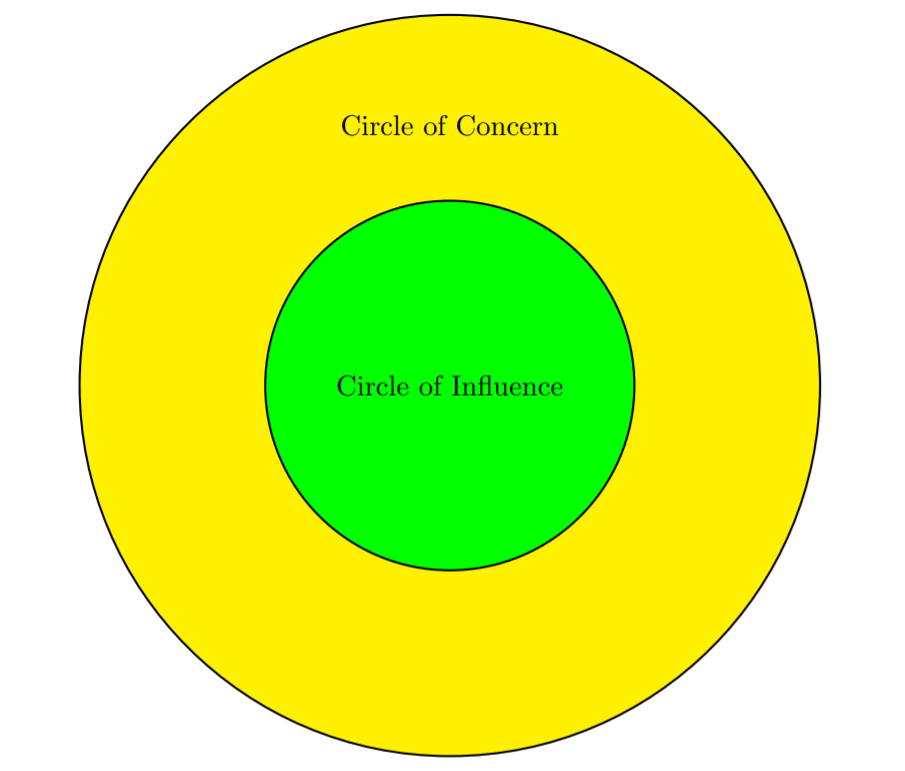
In the 7 habits of highly effective people, the author explains the concepts of our circle of concern and our circle of influence. The circle of concern includes everything that worries you (for e.g., the economy, climate change, someone else’s behavior, etc.) The circle of influence lies within the circle of concern and includes everything that you can change through your own actions. Spending time within your circle of concern but outside your circle of influence could be overwhelming and ineffective. This doesn’t mean you should become apathetic. On the contrary, it means you should do what you can about a problem and then stop worrying about the rest. For instance, you could donate to organizations supporting a cause or make changes in your lifestyle that help the situation. As you operate more in your circle of influence, you will slowly see it expand. Small actions can be very powerful as they create a ripple effect by changing others’ behavior, too.
“Be the change that you wish to see in the world.”
– Mahatma Gandhi
This mindset helped me when my offer for a summer internship in a position I was very keen on having was rescinded because of covid-19. I was disheartened because I’d lost the chance to learn a lot and gain some practical experience. But I had learnt the lesson of taking charge of my life. I would not allow external circumstances to drive my life. I wouldn’t sit in the back seat of my own metaphorical car but would steer it in the direction I wanted to go. The core idea was to shift my perspective and operate within my circle of influence. I put this principle into action. Here, I’ve broken it down into practical tips to help you deal with setbacks in this pandemic.
1. Pick up something that engages you. It could be your hobby or learning a new skill. Set a new goal for yourself to channel your energy in a constructive way because that lies within your circle of control. Among other goals, I decided to focus on 2 areas. Without hesitating, I enrolled in 4 online graduate-level courses. And I started writing. Something that I’d always wanted to do but until now, didn’t have a strong enough reason. Well, now I had one. I wanted to share 18 years of my experience learning and 15 years of my experience reading in a way that could help people.
2. Take responsibility of your health. Not having to walk to work or hit the gym, you could laze around the house, and let your health get spoilt or you could learn Yoga or exercise and cook healthy meals for yourself. You get to decide.
3. Spend less time on consuming news. Every morning, I would watch the news while having breakfast. What a wonderful way to begin the day! Getting bombarded with the number of coronavirus cases, unemployment rates, and politics really makes you feel optimistic and energized, right? Of course, you should be aware of what’s happening around you. But unless it’s going to drive you to do something about it, don’t dwell on it for a long time, and definitely not the first thing in the morning. Constantly checking news feed on your smartphones is another distraction you should get rid of. Spend less time outside your circle of influence.
4. Find things for which you can be grateful. The pandemic has hit everyone in some aspect of their life or the other. Which aspect is intact? Be thankful for that. Focusing on what you have will help combat the negativity.
5. Be kind to yourself. Realize that it’s okay to be overwhelmed sometimes. It won’t always be possible to keep negative emotions at bay. Take some time to connect with friends and family. No matter how many people preach about making the most of your time, there could be days you don’t want to do anything. It’s your mind telling you it needs rest from actively trying to keep you productive, while fighting every other instinct. So, take a break, once in a while.
The coming years could be challenging. Make sure you consciously choose your attitude, right now, and act on it. I hope you emerge from 2020 stronger than ever before.
“It is well with me only when I have a chisel in my hand.”
– Michelangelo
* Photo by Jaromír Kavan on Unsplash
 Human Nature