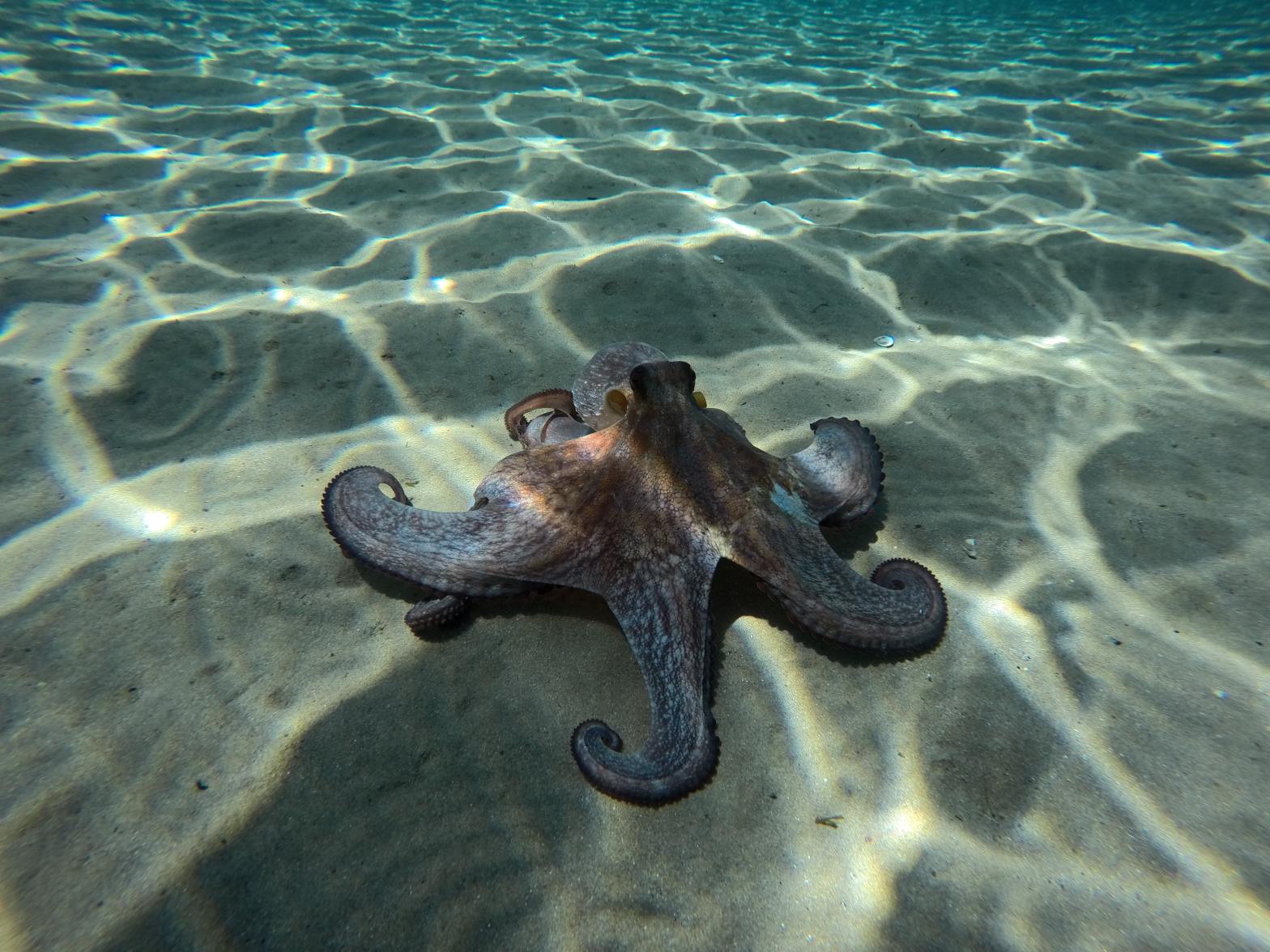
Inky the octopus must not have been too happy in his tank at the National Aquarium of New Zealand.
I know I wouldn’t be if I was locked up in a small room like a prisoner for a crime I didn’t commit.
Inky wanted out. And one night, he got just the opportunity. The lid of his tank had mistakenly been left ajar.
Inky hauled himself out from water and under the loose lid and made his way across the floor. About 13 ft away, he came across a drain that emptied into the Pacific Ocean into which he made his escape. The great escape was later pieced together by the staff by the trail he left behind.
In ‘The Soul of an Octopus’, author and naturalist Sy Montgomery wrote about the octopuses she met at the New England Aquarium. Each octopus showed its curiosity towards her by reaching out to grasp her hands and studying her with sight and touch. There are accounts of some octopuses in aquariums that funneled water from their tank to squirt specific people they want to tease or even get back at for an offense every time they saw them!
Divers have encountered octopuses in the wild watching them with interest and even cautiously probing them with one arm to touch the humans. This curiosity, observant nature, playfulness, and memory (one recognized its previous water gun target even after months) are signs of high intelligence.
Aquariums are a place sure to bore these highly intelligent creatures. With their intelligence, strength, and the ability to camouflage and squeeze themselves out of tiny holes, octopuses often attempt to escape from their tanks. Their ability to survive outside water for some time means they might just find their way out to safety.
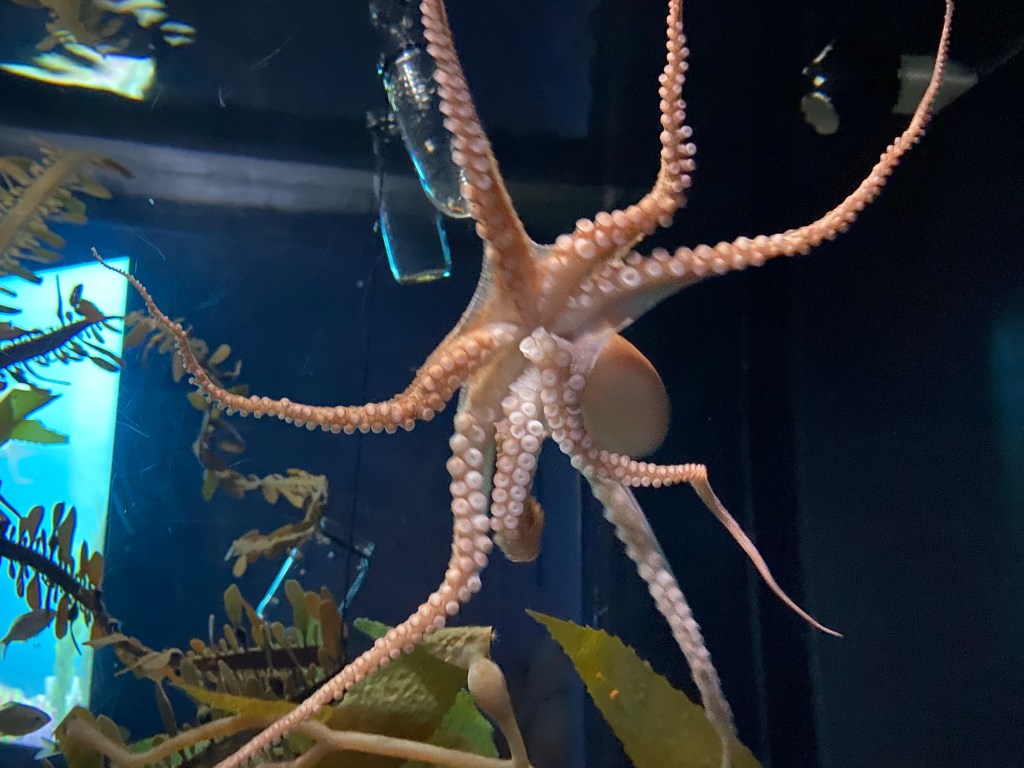
In the award-winning documentary ‘My Octopus Teacher’, Craig Foster records meeting a wild common octopus underwater in South Africa. Initially, the octopus was shy and observed Craig from her little den. After a few more visits, she started trusting Craig and even occasionally played with him.
Craig once recorded an exciting chase of the octopus being hunted by a pajama shark. The octopus employed a number of tricks from hiding in the kelp to even surfacing on the rocks outside the water in an attempt to escape the shark (octopuses can survive for up to 30 minutes outside water). Returning underwater, she covered herself up with hard shells to protect her soft body from the shark’s attack (like a human soldier donning armor), finally maneuvering herself to latch on to the shark’s back where it could not possibly reach her!
With quick thinking under pressure, the octopus outwitted her predator.
Octopuses are also masters of deception. They can quickly camouflage by changing colors, patterns, and texture to confuse their prey and predators or to communicate emotions.
Another compelling evidence of their intelligence is their use of tools (a skill once considered unique to humans). An octopus was observed to pile up stones in front of its den to fortify itself from predators.
An even more creative and complex manipulation of objects was observed in Indonesia. Octopuses collected discarded coconut shells that had been split into two parts, nested one half inside the other, then carried them away and then assembled the two shells into a sphere with themselves inside it like a portable den!
Their intelligence was surprising to me. Maybe because we haven’t lived with them like we did with cats and dogs making it possible to observe our pets’ intelligent behavior. Or maybe because octopuses are invertebrates, typically believed to be less intelligent than vertebrates.
Or maybe because they are so different from us. Unlike humans, octopuses have a distributed nervous system with two-thirds of their neurons in their tentacles. Even when severed, an arm is capable of functioning independently for a while! Their unique anatomy: blue blood, eight legs, three hearts, and distributed brain make them one of strangest creatures on the planet.
Because the latest common ancestor between humans and octopuses existed 600 million years ago, their evolution has been completely seperate from our own. According to Peter Godfrey-Smith, author of ‘Other Minds: The Octopus, The Sea, and The Deep Origins of Consciousness’, “this is probably the closest we’ll come to meeting an intelligent alien.”
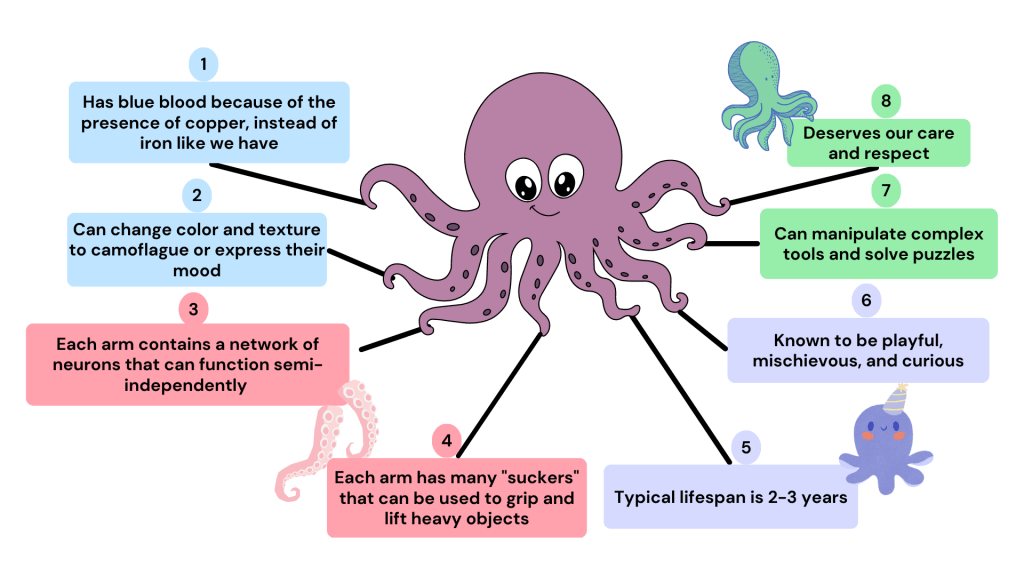
It was only last year that the UK finally recognized that octopuses and shellfish are “sentient” which means they can feel emotions like pleasure, fear, and pain, a term that was earlier reserved only for vertebrates. The existing Animal Welfare laws in the US and the NIH do not consider their kind of animals (cephalopods) to be “animals”! Therefore, there are no regulations in place on their treatment in labs conducting research on them.
It’s also a shame how they’re treated in restaurants worldwide, being reduced to a “delicacy”.
Unfortunately, a Spanish multinational company has proposed an octopus “farm” where a million octopuses would be raised, with 10-15 octopuses be kept in tank sized a cubic meter!
The plan for these intelligent and curious animals being fed a diet of “discards and by-products” of already-caught fish, crammed in a tiny space with others, treated like products on an assembly line, and then frozen to death is unbelievably cruel.
So how can you help an octopus today?
- Don’t put them on your plate. Simple. They are so much more than a fancy dish.
- Support campaigns that call for banning octopus farming like this petition.
Here’s hoping for a world where every octopus is respected; where our empathy extends to include those that are different from us.
References:
https://www.nytimes.com/2016/04/14/world/asia/inky-octopus-new-zealand-aquarium.html
https://www.gov.uk/government/news/lobsters-octopus-and-crabs-recognised-as-sentient-beings
https://www.bbc.com/future/article/20220720-do-octopuses-feel-pain
https://plantbasednews.org/culture/ethics/uk-government-octopuses-lobsters-crabs/
https://www.neaq.org/blog/octopus-box/
https://www-bbc-co-uk.cdn.ampproject.org/c/s/www.bbc.co.uk/news/science-environment-64814781.amp
https://academic.oup.com/icesjms/article/72/2/414/2801391
Photo by Kostas Morfiris on Unsplash

