
William McKeever was onboard a boat with two fishermen in Montauk, New York. His goal was to film a shark hunt, which he later described in his book, ‘Emperors of the Deep – The Ocean’s Most Mysterious, Most Misunderstood, and Most Important Guardians‘. Several teams were participating in this “tournament” aiming to catch the biggest shark. The victim in this case — a mako shark.
Mako sharks are intelligent, swim as fast as 45 mph, grow to 1000 pounds..and are endangered. With their intelligence, speed, and strength, they put up a tough fight for their life.
In this particular hunt, after catching the bait, the shark fought for its dear life for half an hour before finally being hauled on deck where it thrashed about until the fishermen stabbed its throat, pushing the knife deeper until its spinal cord was severed. The mako died several minutes later after a valiant battle. It was a teenager.
When weighed, it was under the 175 pound minimum and therefore, didn’t qualify. It died for nothing.
By the end of the competition, the ground was littered with parts of the sharks’ body, when an hour ago they’d been swimming in the water minding their own business. The fishermen had cut them up into pieces to transport them, where they would later proudly put them up on walls in a gruesome display of cruelty.
There are over 30 shark hunting competitions like these on the US east coast; the massacre sponsored by local businesses and corporations.
This may sound disturbing to you. Horrifying, even. But maybe it’s still a little tough to empathize with the animals known to be man-eaters? After all, wouldn’t they have ripped us apart in the same heartless way given a chance?
As it turns out, they wouldn’t.
Humans are foreign to the ocean and therefore, not a prey of sharks. Only around 50 people in the US are attacked per year, with 25% of those attacks being provoked by humans. Most of those bites are no more severe than a dog bite. And US accounts for 50% of worldwide shark attacks thanks to a long coastline and popularity of recreational activities at the beach.
While the media is quick to jump on sensational shark attack stories, playing on our deepest fears, an average of only one person a year dies from a shark attack in the US.
And the reason a shark attacks? It’s because when a surfer falls and splashes into the water, sharks think it’s a prey in distress that can be caught. So, it attacks by mistake, not because it’s an evil man-eater. Granted, a very scary mistake but when they realize it’s just a tasteless human, they give up. Because honestly, if they wanted to kill us, they totally could.
The famous 1975 Steven Spielberg movie ‘Jaws‘, adapted from a book by Peter Benchley, painted sharks as cold-blooded man-killers and firmly established their sinister reputation. But Peter Benchley later wrote another book ‘Shark Trouble‘ in which he explains that hype and sensational news undermines the need to enable people to understand marine ecosystems. He expressed how sharks could not possibly be cast as villains now that we better understand them.
What made Benchley change his perspective? Perhaps it was because of a sight that shocked him. Benchley was scuba diving off Cosa Rica when he came across dead bodies of several sharks without their fins on the seabed. The reason they were finless is just as horrifying as the shark hunting tournament.
You see, shark fins are used to make a shark fin soup, an Asian “delicacy” that costs over $100. Fishers chop off sharks’ fins alive and dump them back into the ocean where they drown and die a painful death, unable to swim in their own home.
Who’s the cold-blooded killer now?
Because unfortunately, our assault on these aquatic animals and their most basic rights extends beyond these battlefields.
They’re also killed by the millions for their “products” (read, body parts).
A ridiculous claim that shark cartilage could stop cancer made by the medical supplement industry was covered by a popular TV show. Even though a study found that it could not benefit cancerous patients, the $30 million industry continues to be the reason sharks die for no reason.
They are killed also for squalene, a chemical compound found in plants and animals, extracted from their liver oil. Squalene and its derivative, squalane, is a common ingredient in several cosmetic products ranging from sunscreen to lipsticks.
Furthermore, the global fishing industry is a major reason sharks are endangered. Gigantic trawlers unsustainably cast wide nets and catch everything that comes in the way, including many unintended animals including sharks. A study found that fishing was the greatest cause of death for juvenile great white sharks off the western coasts of Southern California and Mexico.
Moreover, the global tuna industry is expected to cross $50 billion by 2030. This kind of demand is extremely unsustainable. The Atlantic bluefin tuna has dropped to 13% of its levels from 70 years ago. This problem is worsened because for every 10 tuna caught through indiscriminate fishing methods, 5 sharks get caught too.
Forced labor, a type of modern slavery, is prevalent on distant-water fishing vessels. Greenpeace Asia and Greenpeace Southeast Asia investigated several cases of workers from 40 different vessels. They found that some workers were made to work 20 hours a day. They were given dirty drinking water and insufficient, inedible, and spoiled food.
When someone buys a cheap tuna can, they don’t know the enormous hidden price being paid by these humans, sharks and the ecosystem.
On an average, sharks kill 4 people a year worldwide. Humans, however, recklessly and mercilessly kill 100 million sharks a year! That makes us the scariest predator in the ocean.
It backfires on us and on the whole planet. Because sharks play a crucial role in maintaining the balance and health of marine ecosystems. Being apex predators, they prevent other species from becoming overpopulated, which would disrupt the ecosystem’s equilibrium. Some species, like nurse sharks, feed on algae, which controls algae levels. This ensures the health of coral reefs, which support a wide range of marine species. In these ways, different shark species support a balanced and diverse ecosystem, which is more resilient towards climate change and pollution.
Another of their important contributions is protecting sea grass. Sea grass is a remarkable mechanism for carbon capture. It also acts as a natural water purifier, removing disease-causing pathogens and detoxifying chemical runoffs. By controlling the population of animals that graze on it, sharks allow sea grass to flourish, providing enormous environmental benefits to the marine ecosystem.
By their position in the ecosystem, sharks not only ensure their own survival but that of the marine ecosystem and the environment as a whole.
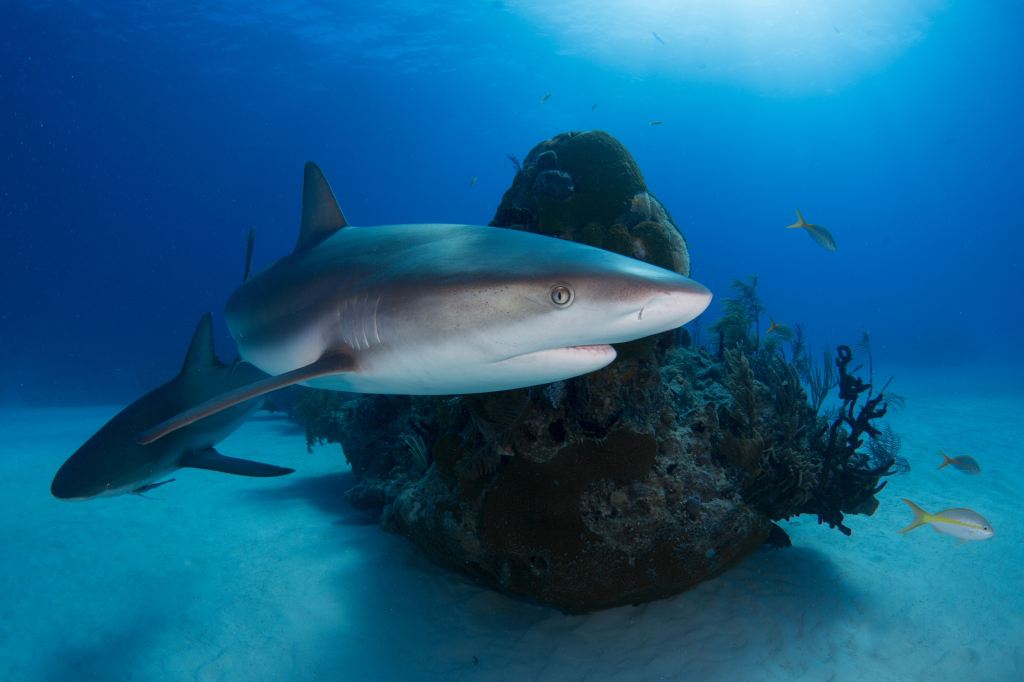
Beyond the environmental service they provide as a species, sharks also have a right to live as individuals for their own sake.
Dr. Tristan Guttridge, a renowned shark researcher, conducted a study on lemon sharks, a species found in shallow, tropical and subtropical waters. The study revealed fascinating insights about the behavior of young lemon sharks. Some individuals displayed a curious nature, eagerly exploring their surroundings, while others preferred to remain in familiar territories.
Additionally, Dr. Guttridge’s research involved dividing the sharks into two groups. One group was exposed to a food dispensing mechanism, and the knowledgeable sharks were then paired with members of the other group who hadn’t seen it before. Surprisingly, the sharks taught their counterparts about the mechanism, demonstrating the ability to share their knowledge.
In many such ways, sharks are like us. And like us, they all have the right to life and liberty.
But disregarding the important role they’ve played in protecting our planet for 400 million years and disrespecting their right to life, we have waged a ruthless one-sided war against them.
It shows how incomplete and prejudiced our knowledge of sharks has been so far because of the stories we’ve been told and the facts that have been hidden. The reality of sharks that we examined here can be summarized as follows.
Sharks are individuals, who have become victims of extreme human cruelty and exploitation. They’re guardians of the environment that have become gravely endangered.
So how can you help save sharks today?
1. Don’t eat shark fin soup. That’s a no-brainer.
2. Buy cosmetics that free from shark-derived squalene or squalane. Check the list of ingredients on the product and if it contain these compounds, verify that is labeled 100% plant-based or vegan to ensure no sharks have been killed to make it.
3. Reduce consumption of seafood including tuna because of the unintended consequences of the industry. Consider substituting with plant-based seafood or if you cannot avoid it, only choose fish caught by small local fisheries.
4. Check seafood labels to ensure it doesn’t contain shark meat by another name. Here’s a link for more info – https://www.opsociety.org/shark-meat.
Our own fate is interconnected with that of these amazing animals. Hope we recognize the reality and goodness of sharks and how much they need and deserve our protection.
References:
The primary reference for this article is the book, “Emperors of the Deep ” – William McKeever.
- https://www.floridamuseum.ufl.edu/shark-attacks/yearly-worldwide-summary/#:~:text=The%20Florida%20Museum%20of,humans%20and%2032%20provoked%20bites.
- https://www.nytimes.com/2007/06/03/health/03cancer.html
- https://www.bloomassociation.org/en/wp-content/uploads/2013/10/ENG_Squalene_4-pager.pdf
- https://www.pewtrusts.org/en/research-and-analysis/reports/2020/10/netting-billions-2020-a-global-tuna-valuation#:~:text=With%20a%20combined%20worth%20of,%2C%20top%2Dshelf%20bluefin%20sashimi.
- https://www.fortunebusinessinsights.com/amp/industry-reports/tuna-fish-market-100744
- https://www.greenpeace.org/international/story/59591/three-reasons-to-rethink-tuna/
- https://thediplomat.com/2018/05/the-dirty-secret-of-taiwans-fishing-industry/
- https://www.nola.com/news/environment/population-of-prized-tuna-species-decline-as-protections-ease-in-the-gulf-of-mexico/article_9612fa64-f449-11ea-adcf-efaf33d0785c.html
- https://besjournals.onlinelibrary.wiley.com/doi/full/10.1111/1365-2664.13158
- https://new.nsf.gov/news/sharks-meet-seagrass-protectors
- https://www.cbsnews.com/news/peter-benchleys-shark-trouble/
- https://www.drguttridge.com/research
Cover photo by Oleksandr Sushko on Unsplash


Very informative. Good to know someone thinks so deep and long term.
Every species has a reason to exist.
Understanding the same is as good as a daily prayer.
LikeLiked by 1 person